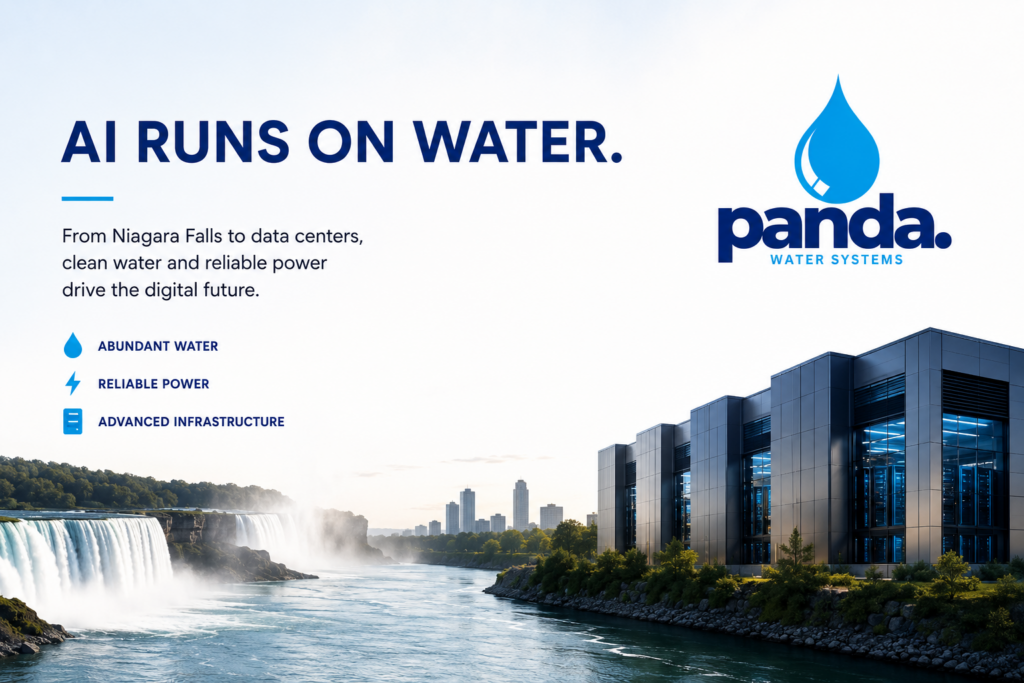
Artificial intelligence, cloud computing, online banking, streaming services, and countless digital tools have become part of everyday life. Behind all of these technologies are massive facilities known as data centers.
A proposed multi-billion-dollar data center campus in Niagara Falls has sparked conversations throughout the community. While many people are focused on the economic impact and job creation potential, there is another important aspect that often goes unnoticed:
Water.
At Panda Water Systems, we believe understanding how large-scale developments interact with our local water resources is important for homeowners, businesses, and our community as a whole.
What Is a Data Center?
A data center is a highly specialized facility that houses thousands of computer servers and networking systems. These facilities store, process, and transmit the data that powers websites, mobile apps, artificial intelligence, cloud storage, financial transactions, and more.
Every Google search, online purchase, social media post, and AI-generated response relies on servers operating inside data centers somewhere in the world.
As our dependence on technology continues to grow, so does the demand for larger and more powerful data centers.
Why Is Niagara Falls Attractive for Data Centers?
Niagara Falls offers a unique combination of resources that make it attractive to large technology companies and developers.
Abundant Hydroelectric Power
The Niagara region is home to some of the most significant hydroelectric power generation facilities in North America. Access to reliable and relatively low-cost electricity is one of the most important factors in data center site selection.
Data centers consume enormous amounts of energy. A large facility can require as much electricity as a small city. The availability of hydroelectric power in Niagara Falls provides a significant advantage.
Existing Infrastructure
The region already has access to transportation networks, utility services, and telecommunications infrastructure needed to support large-scale developments.
Access to Water Resources
Water plays an important role in many data center cooling systems. The proximity to one of the world’s largest freshwater resources is another factor that makes Niagara Falls an attractive location for technology investment.
Why Do Data Centers Need Water?
Most people think of data centers as buildings full of computers. What many don’t realize is that computers generate heat.
A lot of heat.
Thousands of servers operating around the clock create temperatures that must be carefully controlled to prevent equipment damage and maintain efficiency.
Many data centers use water as part of their cooling strategy because water is highly effective at transferring heat away from equipment.
Depending on the design of the facility, water may be used in cooling towers, heat exchangers, or advanced liquid cooling systems.
Some modern facilities are designed to minimize water consumption, while others may require substantial volumes of water to support cooling operations.
How Much Water Could a Large Data Center Use?
The exact water requirements of any proposed facility depend on its final design and cooling technology.
Water usage can vary dramatically from one data center to another.
Some facilities use primarily air-based cooling systems and consume relatively little water. Others rely on evaporative cooling systems that require significantly more.
The amount of water consumed depends on factors such as:
- Facility size
- Computing capacity
- Cooling technology
- Seasonal temperatures
- Operational efficiency
As technology evolves, many developers are pursuing more water-efficient cooling methods to reduce environmental impact and operating costs.
What Happens to the Water After It Is Used?
One common misconception is that data centers create industrial wastewater similar to manufacturing facilities.
In reality, data centers do not typically produce products or industrial chemicals. Their primary challenge is managing heat.
Water used in cooling systems may eventually require treatment or replacement through a process known as blowdown. During this process, concentrated minerals and treatment chemicals are removed from the cooling system to maintain efficiency.
Depending on the system design, discharge water may contain:
- Elevated mineral concentrations
- Calcium and magnesium
- Silica
- Corrosion inhibitors
- Scale prevention chemicals
- Biological control treatments
These systems are generally regulated and designed to meet environmental and wastewater requirements.
Why Water Quality Matters
Whether it’s a family home or a billion-dollar technology facility, water quality plays a critical role in system performance.
Poor water quality can lead to:
- Scale buildup
- Reduced efficiency
- Equipment damage
- Corrosion
- Increased maintenance costs
To protect cooling systems, many facilities utilize advanced water treatment technologies such as:
- Sediment filtration
- Activated carbon filtration
- Water softening
- Reverse osmosis
- Deionization systems
- Continuous water quality monitoring
These same principles apply to residential and commercial water treatment systems throughout Western New York.
What Does This Mean for Niagara Falls Residents?
The proposed data center development highlights something water professionals have understood for years:
Clean, reliable water is one of our most valuable resources.
As technology continues to expand, communities across the country will face new questions about how water, energy, infrastructure, and economic development work together.
For Niagara Falls, the discussion extends beyond technology. It is also about responsible resource management and ensuring that our community continues to have access to safe, reliable water for generations to come.
The Bottom Line
The proposed data center project demonstrates how closely connected water and technology have become.
While computers, artificial intelligence, and cloud services often dominate the conversation, water remains one of the essential resources that helps make these technologies possible.
At Panda Water Systems, we believe informed communities make better decisions. Whether we’re discussing municipal water quality, well water treatment, or the water demands of emerging technologies, understanding our water resources is more important than ever.
If you have questions about your home’s water quality or would like a free water analysis, contact Panda Water Systems. We’re proud to help Western New York families better understand and improve their water every day.