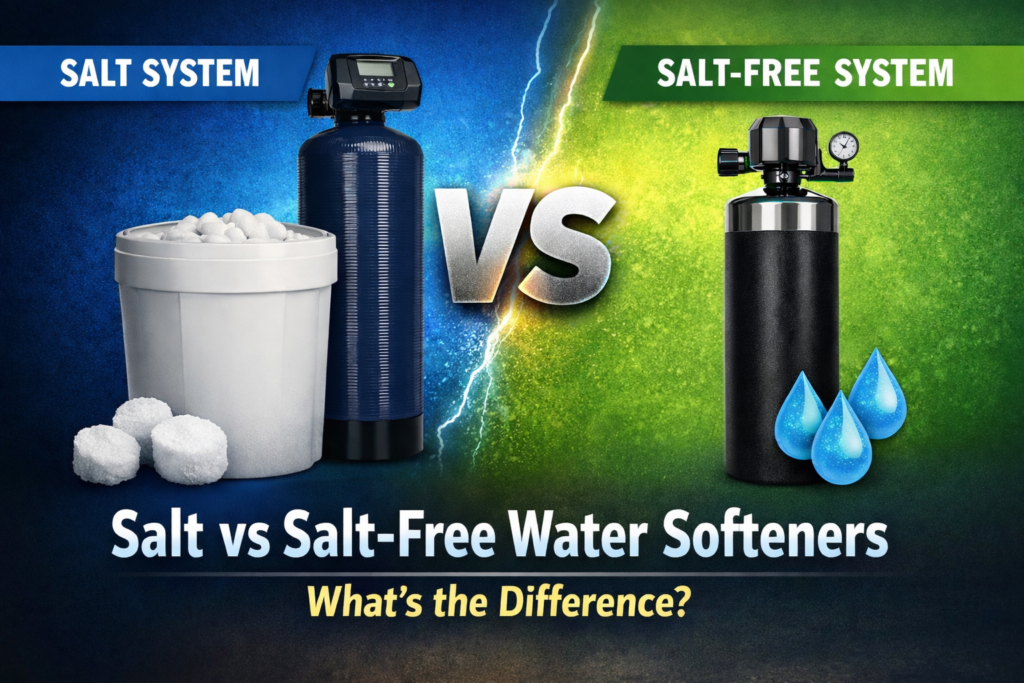
If you’re dealing with hard water in your home, you’ve probably heard about salt water softeners and salt-free water softeners — but the difference between them isn’t always clear.
Homeowners often ask us:
- Do I really need salt?
- Is salt-free better or just easier?
- Which option actually works for my home?
Let’s break it down in plain English so you can make the right decision for your water and your household.
What Is Hard Water?
Hard water contains high levels of calcium and magnesium. These minerals can cause:
- White scale buildup on faucets and fixtures
- Spots on dishes and glassware
- Dry skin and hair
- Reduced appliance efficiency
- Shortened lifespan of plumbing and water heaters
Hard water is very common in Western New York, whether you’re on town water or well water.
What Is a Salt Water Softener?
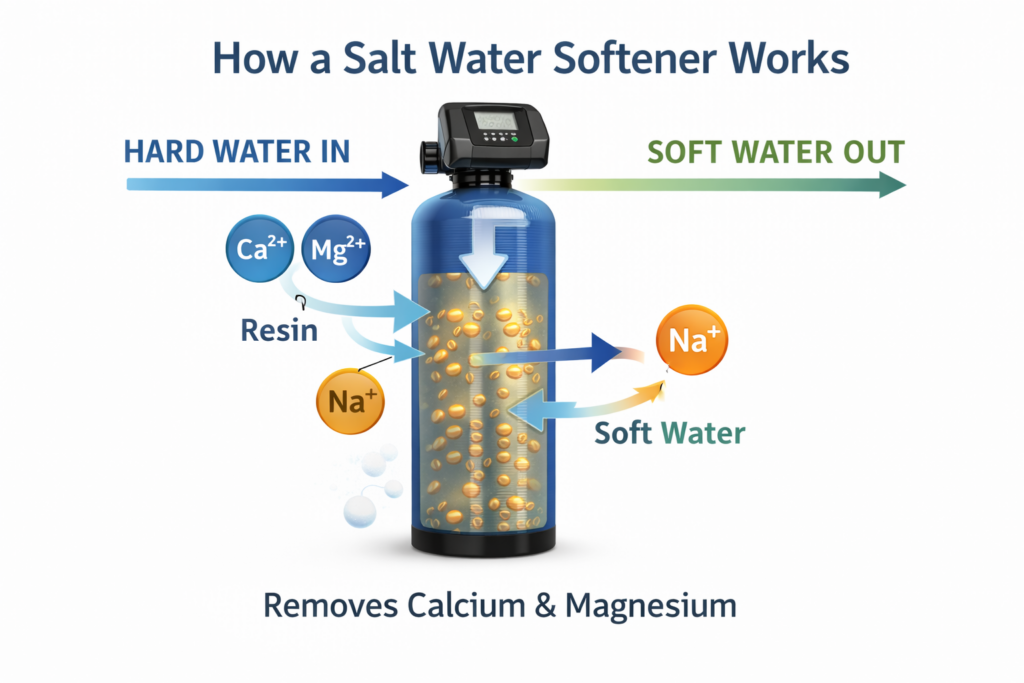
A salt-based water softener removes hardness minerals through a process called ion exchange.
How it works:
Calcium and magnesium are removed from the water and replaced with sodium (or potassium), resulting in truly softened water.
A properly sized whole-house water softener removes hard minerals completely and helps protect your plumbing and appliances.
Pros of Salt Water Softeners:
- ✔ Removes hard minerals entirely
- ✔ Prevents scale buildup in pipes and appliances
- ✔ Softer skin, hair, and laundry
- ✔ Extends the life of water-using appliances
Cons:
- Requires periodic salt refills
- Needs routine maintenance
- Slight increase in sodium (very minimal for most households)
Bottom line:
Salt-based softeners are the most effective solution for hard water.
What Is a Salt-Free Water Softener?
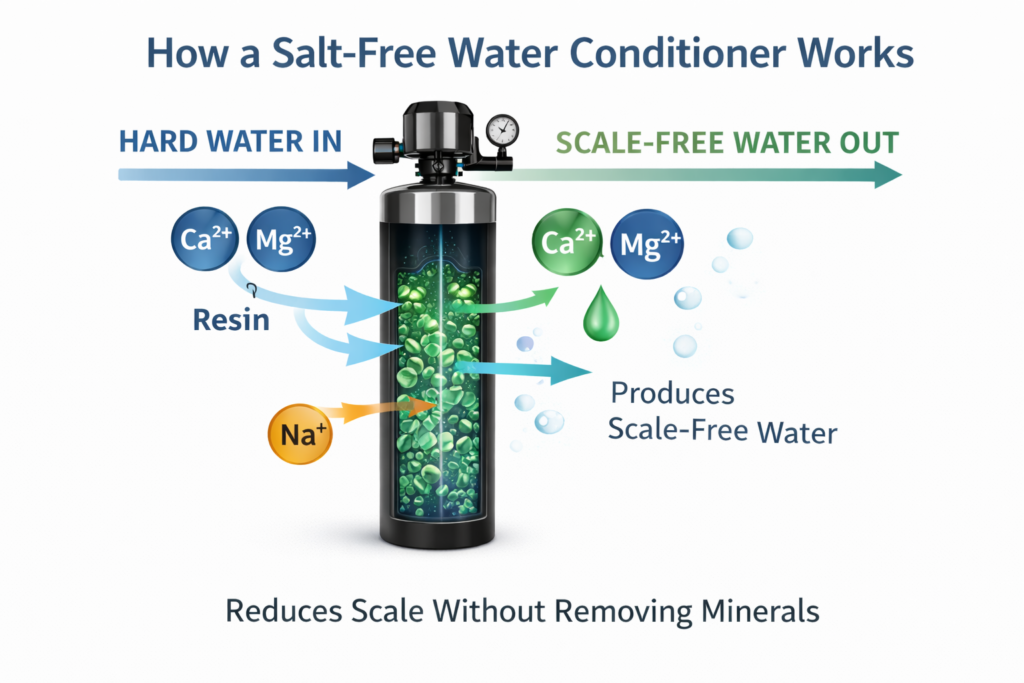
Salt-free systems are often referred to as water conditioners, not true softeners.
How they work:
Salt-free systems do not remove calcium or magnesium. Instead, they change the structure of the minerals so they’re less likely to stick to surfaces and form scale.
Salt-free systems, often called water conditioners, are designed to reduce scale buildup without actually softening the water.
Pros of Salt-Free Systems:
- ✔ No salt to add
- ✔ Low maintenance
- ✔ No wastewater from regeneration
- ✔ Good option where salt discharge is restricted
Cons:
- ❌ Does not remove hardness minerals
- ❌ Scale can still form (just more slowly)
- ❌ Skin and hair will not feel “softened”
Bottom line:
Salt-free systems help manage scale, but they do not soften water.
Salt vs. Salt-Free: Side-by-Side Comparison
| Feature | Salt Water Softener | Salt-Free System |
|---|---|---|
| Removes hardness minerals | ✅ Yes | ❌ No |
| Prevents scale buildup | ✅ Yes | ⚠️ Reduces |
| Softens skin & hair | ✅ Yes | ❌ No |
| Requires salt | ✅ Yes | ❌ No |
| Maintenance | Moderate | Low |
| Best for very hard water | ✅ Yes | ❌ No |
Which System Is Right for Your Home?
A salt-based softener may be best if:
- You have hard or very hard water
- You see scale buildup on fixtures
- You want softer skin, hair, and laundry
- You want maximum protection for plumbing and appliances
A salt-free system may be best if:
- You want low maintenance
- Your water hardness is moderate
- Your main concern is scale reduction
- Salt use is restricted in your area
In many homes, the best solution is actually a whole-house water filtration system paired with softening or conditioning based on water test results.
Why a Water Test Matters
Every home’s water is different.
That’s why we always recommend starting with a free in-home water test to see exactly what’s in your water before choosing a system.
A professional water test helps identify:
- Hardness level
- Chlorine or chemical presence
- Sediment, iron, or other contaminants
From there, we can recommend the right system, not a one-size-fits-all solution.
Final Thoughts
Salt-free systems aren’t “bad” — they’re just often misunderstood.
If your goal is truly soft water, a salt-based water softener remains the gold standard. If you’re focused on reducing scale with minimal maintenance, a salt-free option may make sense.
The key is choosing the solution that fits your water, your home, and your lifestyle.
Ready to Find the Right Water System?
At Panda Water Systems, we offer free in-home water testing and honest recommendations based on your actual water quality.
👉 Schedule your free water test here
or call/text 716-219-4233
Frequently Asked Questions
❓ Is a salt-free water softener as effective as a salt-based softener?
Salt-free water systems do not remove hard minerals from water. They help reduce scale buildup, but they do not soften water the way a salt-based softener does.
❓ Do salt water softeners add sodium to drinking water?
Salt-based water softeners add a very small amount of sodium, usually less than what’s found in a slice of bread. Many homeowners choose a reverse osmosis system for drinking water if sodium is a concern.
❓ Which is better for hard water: salt or salt-free?
For moderate to severe hard water, salt-based water softeners are the most effective option. Salt-free systems are better suited for scale reduction, not true softening.
❓ Are salt-free water softeners maintenance free?
Salt-free systems require less maintenance than salt-based softeners, but they are not completely maintenance free. Filters and media still need periodic replacement.
❓ Do I need a water test before choosing a system?
Yes. A professional water test identifies hardness levels and other contaminants, helping ensure the correct system is installed for your home’s water conditions.